

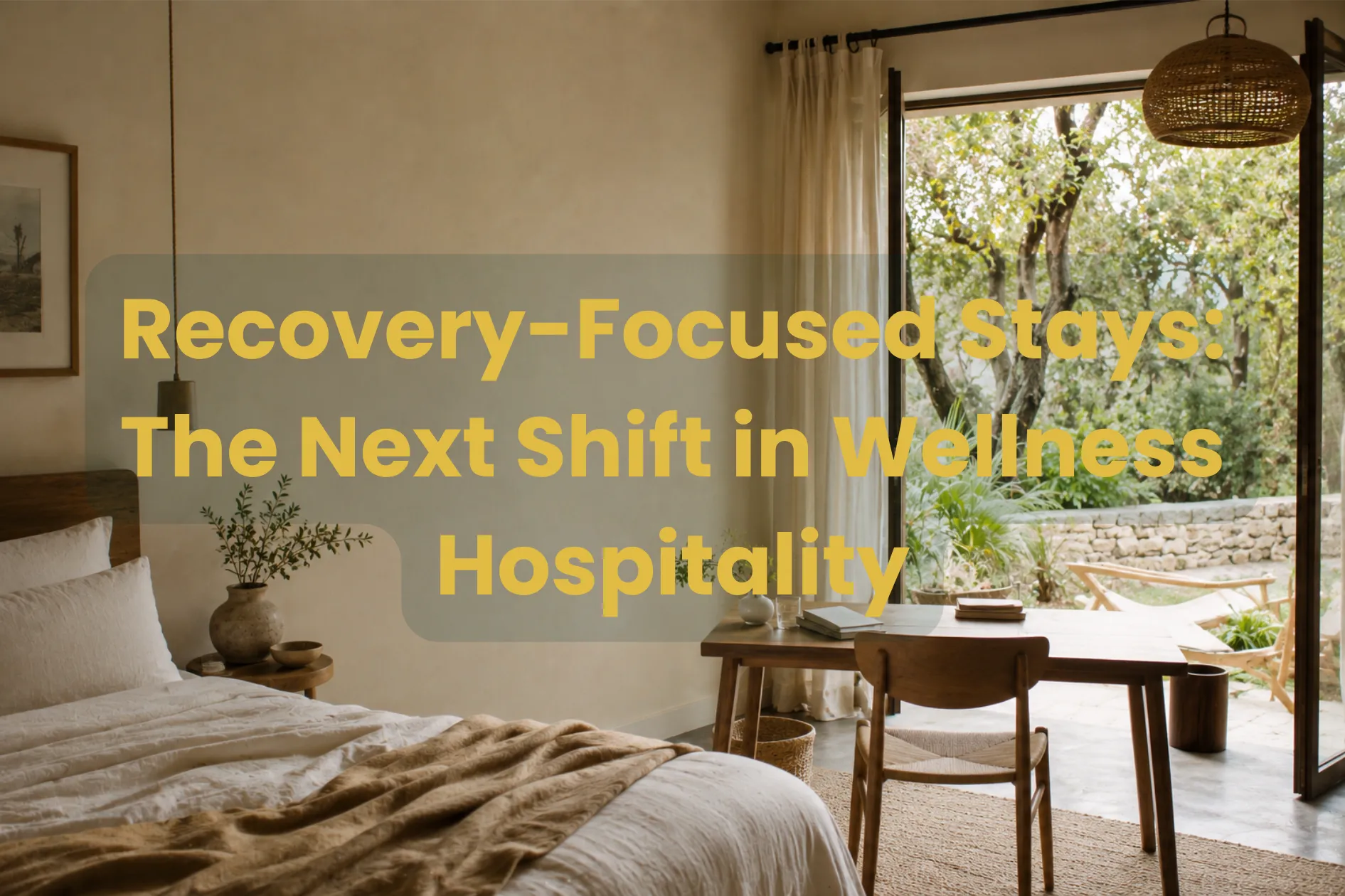
Recovery-Focused Stays: The Next Shift in Wellness Hospitality
Wellness hospitality is changing.
For a long time, wellness was easy to recognize from the outside: a spa menu, a yoga deck, a massage room, a sauna, a smoothie bar, maybe a few retreat packages on the website. Those things still have value, and for some properties they make sense. But they no longer tell the whole story.
More guests are arriving tired in a different way. They are not only looking for a nice break or a beautiful room. They are looking for places that help them sleep better, feel calmer, move more, reduce noise, disconnect from screens and recover from the pressure of daily life.
That is why recovery-focused stays are becoming one of the most important shifts inside wellness hospitality.
This does not mean every host needs to become a luxury wellness resort. In fact, many small stays, rural houses, villas, guesthouses, colivings and nature-led accommodations already have some of the most valuable recovery assets: quiet, space, fresh air, slower surroundings and a more human rhythm.
The opportunity is to understand those qualities better, design around them more intentionally and communicate them clearly.
Wellness hospitality is becoming less about escape and more about recovery
Guests still want to escape sometimes. They still want beauty, comfort and a change of scenery. But many people are now looking for something deeper than a weekend away from their inbox.
They want to feel restored.
That shift matters for hosts because it changes what people value. A stay is no longer judged only by how it looks in photos or how many amenities it offers. It is also judged by how the guest feels while they are there and after they leave.
Did they sleep well? Did the place feel quiet? Could they walk outside easily? Could they eat simply? Could they close the laptop and actually feel the day change? Did the environment help them slow down, or did it keep them stimulated?
The Global Wellness Institute’s Wellness Tourism Trends Initiative describes wellness tourism as a sector shaped by evolving traveler behaviors, destination strategies and new wellness experiences, which shows how seriously the industry is now treating wellbeing as part of travel design. Global Wellness Institute Wellness Tourism Trends
For hosts, the practical message is clear: wellness is no longer only an add-on. It is becoming part of the stay itself.
What recovery-focused stays actually mean
A recovery-focused stay is accommodation designed to help guests rest, sleep, move, focus, breathe and rebuild a healthier rhythm.
It does not have to be medical. It does not have to be expensive. It does not need to include biohacking, luxury treatments or a full retreat program. A recovery-focused stay can be simple, as long as the environment genuinely supports restoration.
That might mean quiet rooms, good bedding, blackout options, natural light, outdoor space, walking routes, clean air, healthy food basics, reliable Wi-Fi, a comfortable work setup, and enough separation between work and rest.
For remote workers, this is especially important. They are not always coming to fully disconnect. Some are staying for a workation, a remote reset or a longer stay where they need to keep working while also recovering from overstimulation, poor routines or city fatigue.
That means a recovery-focused stay has to support two things at once: the workday and the recovery after work.
This is where Slowork’s perspective becomes useful. A better stay is not just a place that looks good. It is a place that helps people work calmly, rest properly and live with a healthier rhythm for a while.
Why this trend matters for hosts
For hosts, recovery-focused hospitality is not just a wellness trend. It is a positioning opportunity.
Many accommodation businesses are competing on the same visible features: location, views, price, design, breakfast, pool, nearby attractions. Those still matter, but they are easy to copy or compare. Recovery is harder to fake because it depends on how the whole stay feels.
Small hosts often have an advantage here.
A rural guesthouse may not have a spa, but it may offer silence at night, fresh air, morning walks and a slower pace. A villa may not have a wellness program, but it may offer privacy, a kitchen, natural light and enough space for a guest to work and rest. A coliving space may not feel like a retreat, but it may offer community, routine and a healthier work-life rhythm.
Hosts do not need to add “wellness” as a vague label. They need to identify the recovery value that already exists in their place and improve the parts that matter most.
The question becomes less “How do we look more like a wellness hotel?” and more “How does this stay help people recover in real, practical ways?”
What guests are really trying to recover from
To understand recovery-focused stays, hosts need to understand what guests are carrying when they arrive.
Some are recovering from poor sleep. Others are coming from noisy cities, screen-heavy jobs, long commutes, burnout, constant notifications, social exhaustion or work-life boundaries that have disappeared. Some are not burned out in a dramatic way, but they feel flat, overstimulated or disconnected from their body.
For remote workers, the problem can be even more specific. They may not need a holiday in the traditional sense. They may need a better environment to work from: somewhere with quiet mornings, natural light, a proper table, stable internet, and a place to walk after calls.
This is why recovery-focused stays are not only about leisure travelers. They also matter for people who are working while they travel.
Slowork’s article on why your work environment matters explores this idea from the remote worker side: the environment affects focus, mental wellbeing and how the workday feels. For hosts, the same idea becomes a business insight. If your property helps people feel better while they work and rest, that is part of your value.
Guests are not only asking, “Is this place beautiful?”
They are also asking, “Will I feel better after staying here?”
Recovery does not have to look like luxury
One mistake in wellness hospitality is assuming that recovery has to look expensive.
It does not.
Recovery does not always need a cold plunge, a medical program, a spa therapist or a luxury retreat package. Those may work for some properties, but they are not the only way to create value.
For many guests, recovery begins with much simpler things: sleeping through the night, waking up to natural light, hearing less noise, being able to walk outside, having a comfortable place to work, eating normal food, and ending the day somewhere that does not feel rushed.
A simple stay can be deeply restorative if it is designed with care.
This is good news for small hosts because it means recovery-focused hospitality is accessible. A boutique guesthouse, rural home, eco-lodge, small coliving or remote-ready villa can compete through atmosphere, rhythm and usefulness, not only through luxury amenities.
The key is honesty. Do not overpromise transformation. Do not pretend a quiet room is a clinical recovery program. Instead, communicate what the stay genuinely supports: sleep, calm, movement, focus, nature and slower days.
That is often more believable than big wellness claims.
What a recovery-focused stay needs to get right
A recovery-focused stay starts with sleep.
Hosts should pay attention to the basics: good bedding, comfortable temperature, quiet rooms, blackout curtains or shutters where possible, and honest information about noise. If there is a road nearby, say so. If mornings are quiet but evenings are lively, explain that clearly. Guests looking for recovery value honesty more than perfect marketing.
Calm and quiet also matter. This does not mean the property has to be silent, but guests should feel that they can downshift. A garden, terrace, reading corner, quiet common area, slow check-in process or low-pressure hosting style can all help the stay feel less rushed.
Nature and movement are another major part of recovery. The Global Wellness Institute’s 2025 wellness tourism trends point to green and blue wellness development, with destinations investing in wellbeing through nature, water, parks and outdoor environments. Global Wellness Institute 2025 Wellness Tourism Trends
For small hosts, this does not require building anything dramatic. It may simply mean helping guests understand what is already nearby: walking routes, swimming spots, forests, beaches, hills, gardens, cycling paths or quiet streets. Nature becomes more valuable when it is easy to access during ordinary days.
Remote-ready work conditions are also essential if the host wants to attract remote workers or long-stay guests. Reliable Wi-Fi, a real table or desk, a comfortable chair, natural light, enough plugs, call-friendly areas and honest workspace photos can make a big difference. Remote workers notice details that weekend guests may ignore.
Food and daily rhythm also support recovery. A kitchen, simple breakfast, local produce, good coffee, tea, water and easy access to groceries can help guests build a healthier routine. Recovery is not only what happens in a treatment room. It is also what happens when daily life becomes easier.
Finally, recovery after work should be part of the stay. Guests need places where the day can shift: a terrace, garden, pool, sauna, yoga space, walking path, reading chair or quiet outdoor area. The point is to help the guest feel that the laptop does not define the whole day.
Why remote workers are an important guest segment
Remote workers experience a property differently from tourists.
A weekend guest may care most about location, comfort and what to do nearby. A remote worker cares about those things too, but they also notice how the property functions over several normal days.
They notice whether the Wi-Fi drops during calls. They notice whether the chair becomes uncomfortable after two hours. They notice whether the room is too dark at 3pm, whether there is noise during working hours, whether food is easy to organize, and whether they can recover after a full day of screen time.
This is why recovery-focused hospitality and remote-ready hospitality are becoming connected.
A remote worker does not only need a desk. They need an environment that supports focus during work and recovery after work. If a stay can do both, it becomes more valuable for longer stays, workations and remote resets.
Slowork’s guide on planning a 2-week workation without using all vacation days connects directly to this need. People are looking for short periods in better environments where they can keep working while feeling more restored. Hosts who understand this can position their property for a growing type of guest.
How hosts can position a stay around recovery
The way hosts communicate recovery matters.
Generic wellness language is easy to ignore. Phrases like “relax and recharge” or “perfect wellness escape” do not say much unless the listing explains why the stay helps people recover.
Better positioning is specific.
Instead of saying “ideal for relaxation,” say what creates that feeling: quiet mornings, blackout curtains, walking trails from the door, no traffic noise at night, a garden for reading, reliable Wi-Fi, a proper work table, local food nearby, or a calm village rhythm.
Hosts should help guests imagine a normal day.
What does the morning feel like? Where can they work? Where can they walk after calls? What happens when the laptop closes? Can they cook? Can they sleep well? Can they avoid driving for every small errand? Can they stay for two weeks and build a rhythm?
For example, a host might say:
“Designed for longer stays, deep work and slow evenings.”
Or:
“Quiet mornings, reliable Wi-Fi and walking trails from the door.”
Or:
“A calm base for remote workers who need nature, focus and proper rest after work.”
This kind of language is more useful because it connects the physical property to the guest’s real need.
Mistakes hosts should avoid
The biggest mistake is calling everything wellness.
If every nice room, garden or breakfast becomes “wellness,” the word loses meaning. Guests are becoming more aware, and vague claims can feel empty.
Another mistake is overpromising recovery. A stay can support recovery, but it cannot guarantee transformation. Hosts should avoid making medical or emotional claims they cannot prove. It is better to say, “This is a quiet place with nature nearby and a work-friendly setup” than to promise that guests will leave healed.
Hosts should also avoid focusing only on spa amenities while ignoring basics. A massage room does not help much if the bedroom is noisy, the Wi-Fi is weak, the chair is uncomfortable or the guest cannot sleep well.
For remote workers, hiding workspace details is another common problem. Beautiful bedroom photos are not enough. Show the desk, the table, the chair, the light, the plugs, the view from the workspace and the internet information. If the stay is remote-ready, make that visible.
Finally, avoid selling escape without rhythm. Recovery-focused guests are not always looking for a dramatic escape. Many are looking for a place where normal life feels healthier. That is a different promise, and often a stronger one.
What this means for the future of remote-ready hospitality
The future of wellness hospitality is not only about adding more treatments.
It is about designing better stays.
Places where guests can sleep well, work calmly, move easily, access nature, eat simply and feel the day slow down. Places that support recovery through the whole environment, not only through a paid add-on.
The Global Wellness Summit has described the future of wellness in travel and hospitality as a major topic for industry leaders, linked to shifting consumer desires and new ideas in wellness tourism. Global Wellness Summit on wellness in travel and hospitality
For small hosts, this shift should feel encouraging. Recovery-focused hospitality does not belong only to large hotel groups. It belongs to any place that can help people feel better through quiet, care, nature, rhythm and thoughtful design.
For Slowork, this is where remote-ready stays become more than accommodation. They become part of a healthier way to work and live for a while.
The next shift in wellness hospitality may not be louder, more luxurious or more complicated.
It may be quieter.
More intentional.
More useful.
A recovery-focused stay does not need to promise transformation. It needs to make the conditions for rest, focus and better rhythm easier to access.
Quick FAQ
What is a recovery-focused stay?
A recovery-focused stay is accommodation designed to help guests rest, sleep, reduce stress, move, reconnect with nature and rebuild a healthier rhythm. It may include wellness amenities, but its real value comes from the whole environment: quiet, comfort, light, nature, routine and recovery.
Is recovery-focused hospitality only for luxury hotels?
No. Small hosts, rural houses, guesthouses, villas, colivings and boutique stays can offer recovery-focused hospitality through quiet rooms, nature access, good sleep, work-friendly spaces and slower daily rhythms.
Why do remote workers care about recovery-focused stays?
Remote workers often stay longer and work from the property, so they notice whether the environment supports focus, calm, movement, rest and recovery after work. A stay that helps someone work well and recover properly can be more valuable than one that only looks good.
How can hosts attract wellbeing-focused guests?
Hosts can attract wellbeing-focused guests by communicating specific recovery benefits: quiet rooms, natural surroundings, walkability, remote-ready workspaces, sleep quality, outdoor space and a calmer rhythm. Specific details are more persuasive than vague wellness language.
